Today in motivated reasoning news

It’s party conference time, so everyone’s pushing their ideas into the public domain, hoping they will get picked up by the faithful (and the media) just at the point that policy might get changed.

The IPPR have a useful report on the costs of not having mutual recognition of conformity assessment with the EU, highlighting how this might generate much more economic impact than any of the reset dossiers. Sadly, it doesn’t appear to engage with why the EU has steadfastly refused to even discuss such an agreement for the past several years (spoiler: there’s no good reason for them to do it).

But the eye has been caught much more by the latest report from the Tony Blair Institute, with a foreword from the man himself. This prompted some initial thoughts from me.

At one level, there’s quite a lot to be positive about from the work. It rightly argues (as I’ve been trying to since, well, ages) that the UK needs to develop a more positive vision of what its relationship with the EU should be, grounded in an understanding of how that fits into the country’s development and position in the world, rather than being driven by unhappiness with How Things Are.

It also is correct to note that the UK can’t avoid this, given its exposure to the EU (economically and geopolitically). If Britain gets a cough when Europe sneezes, then being involved in helping Europe not get poorly makes sense.

But these good points are lost in what follows, which reads much like Tony’s Special Wishlist of All The Things.

By becoming a progressive and dynamic place and setting a goal of rejoining within the next decade, the UK can more effectively press for new deals with the EU that serve the former’s advantage (calculated by a “Power Maximising Test” that will tell us all what the right level of cooperation is for any given area).

That in turn will also allow the UK to stop the EU doing bad things that hurt it and the UK, because everyone will see that’s the right thing.

Oh, and the EU itself will be simultaneously a much more powerful and effective global actor, speaking with one voice on all manner of things, while also being a “Europe of nation states”, i.e. one that lets each country do what it wants when it needs to.

There is minimal sense that the EU understands itself to have the dominant position in the relationship, as the larger and the less-needy party, nor of how it will see being told how to sort itself out by politicians from a country that – not that long ago – decided it wanted out of the organisation altogether.

There’s also no recognition that the EU has never, ever let itself be changed by non-members’ preferences or needs, and has repeatedly used the accession process to require massive adjustments on the part of the acceding state.

To take one obvious example, the then EEC developed its Common Fisheries Policy in the early 1970s precisely because several new states with large fishing waters wanted to join and the existing members wanted to embed their preferences about access and management before the new lot got a say. Just like the new EU made choices about institutional arrangements and funding for agriculture and regional development before admitting Central and East European states in the 2000s: if only I could remember the name of the guy in charge in the UK back then.

I find it very hard not to lay this at the feet of Blair himself, given how closely this all reads to his previously stated views on the matter. The helpful sections on specific domains of cooperation get lost in the over-extrapolation the report authors are asked to make, for example.

Given that the initial response to the report has been generally as bad as might be expected, it’s tempting just to write this off as Late Stage Blairism and move on.

But again, the diagnosis of the failings of the current (and historic) British approach to European policy still stands up, as does the need to start building an alternative grounded in a positive mission and set of objectives that tie into the country’s wider development.

I don’t think bathwater can be either stupid or ridiculous, but there is still a baby to be saved in all this, and whether that’s done will be a much better marker of whether the UK has got beyond Brexit than anything else in all this.

Posted in Uncategorised | Tagged , , | Leave a comment

Will this do?

I’ve been spending the week at the UACES conference in Prague, talking about lots of things to do with European Studies. However, one the things that didn’t come up very much was UK-EU relations. It’s almost as if most people don’t have it on their minds.

The moment it did come up was during the panel I took part in on the post-Brexit UK, where I talked about the instability of the relationship with the EU, something I’ll be returning to presently. My basic argument was that whatever happens, there isn’t a resilient foundation on which to rest and from which to act.

One question that did come up was whether the current relationship – low-key and benign, if unexciting – wasn’t in fact serviceable enough for our needs. After all, neither side seem that bothered about either a return to the fun times of the Brexit years or starting up a journey to re-accession. London and Brussels have got back in the habit of talking to, and listening to, each other, so can we not just assume that we can work it out as we go? Indeed, in a purely practical sense, if the relationship is as it is, does it not just to suffice, since we’ve not got another one to use instead?

My response to this fits my usual diagnosis of the failings of UK-EU relations, namely that an absence of clear strategic objectives on either side of the relationship mean that the dominant mode is a mix of neglect and bursts of crisis management. Put differently, the absence of obvious problems doesn’t mean that everything’s fine.

For a recent example, consider the mini-fuss over marmalade labelling earlier this year.

As part of the (generally pretty smooth) negotiations on an SPS agreement, DEFRA released a list of EU legislation that UK businesses would have to comply with once the deal is done; a rare example of useful forward planning.

That list got almost no media interest at the time, but some weeks later a story dropped on GB News about how the deal would mean that henceforth marmalade would have to be labelled with which fruit it was made of, and this would be a terrible imposition on already hard-done-by companies.

That almost all marmalade currently on sale in the UK already has such labelling was no barrier to a little (but still much larger than the previous) pile of media pieces appearing. Bendy bananas redux, if you will.

In short, the level of public, media and political interest is low, leaving everyone exposed to silly season pieces (and ill-intentioned actors, should they feel so inclined).

A more serious version of this appeared just as I was putting this piece together.

Politico reported that November’s summit won’t see agreement on ‘Burnham’s big new Brexit deal’, which as readers of this blog will know shouldn’t be news, since Burnham has no deal, big, new or otherwise.

That anyone, including the reporter who definitely knows better, should think that this was the case points to the non-management of expectations by either side and the substantial risk of relations entering into vicious circles of briefings and counter-briefings.

In short, the absence of strategic visions for the relationship in either London or Brussels means that there is no master narrative for politicians to cleave to and to smooth out the small bumps in the road.

As much as technical relations seem to be pretty functional, even these evidently rely on a cadre of people who have built up enough experience of working together out through the original Brexit negotiations, but who are liable to be churned by their respective employers with no robust mechanisms for preserving institutional memory.

None of these issues should be a surprise to anyone, since they have been evident for a long time, and indeed much flagged by the small number of people still focused on the matter. But the concern has to be that the current model of getting by will not have the resilience to cope with the next crisis, whatever that might be.


Posted in Uncategorised | Tagged , | Leave a comment

Not even a new ‘reset’: The minimalist Burnham agenda on the EU?

The arrival of the seventh Prime Minister in Number 10 since the 2016 referendum is an opportunity to try once again to get to grips with British European policy.

In practice, this is not a problem of wrestling Lots of Things, but instead more about trying to work out whether the absence of visible activity is a function of a very tight ship, or of a lack of activity.

Undoubtedly, negotiations on the May 2025 reset agenda in the Common Understanding has progressed well, to the point that several dossiers are largely wrapped up: SPS and ETS are the two big ones. Internal Energy Market talks finally got underway in the early summer too, the last big element to get going.

At the same time, once it became clear that Keir Starmer was stepping down, the EU decided to pause everything, there being little point in making deals with a departing leadership. Moreover, the arrival of a new PM might also offer new opportunities for the EU to secure more concessions, especially if Andy Burnham was really that much more pro-cooperation and wanted to get a quick win.

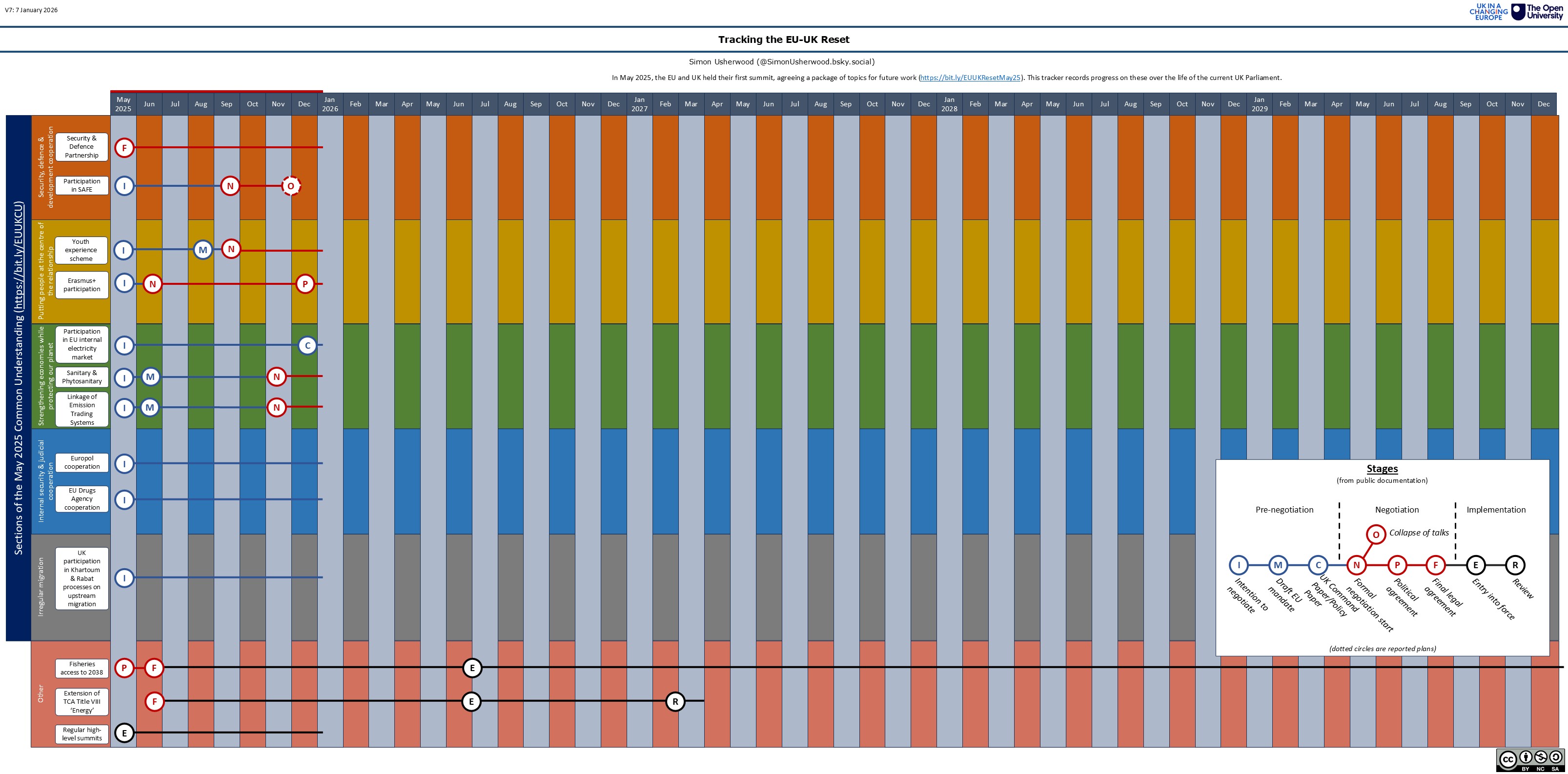
The evidence of the first couple of months of Burnham suggests that this has not been the case. Indeed, as the tracker below (mildly sarcastically) suggests, Burnham’s time in power has been marked by talking about pretty much anything apart from EU policy.

The ‘regular’ EU-UK summit heralded by the Common Understanding, and already rather uncertain by the time of the May anniversary of the first one, has only been pushed back since, with Burnham’s recent talk of November feeling more aspirational that definite. This is not a government in a rush to press forward on things, despite Burnham’s repeated invocations of the damage of Brexit to the economy.

From what little he has said, the impression is very much one of continuity-Starmer: use the reset process to secure some wins, plus avoid the worst effects of the continual activity of the EU to protect and promote its interests. The language about ‘Made in Europe’ reflects another common thread to Starmer, once the UK had determined the potential impacts on high-profile sectors of the economy and the possible leverage of working together in Europe in the face of – how to put it? – debatable international relations.

However, all of this has been very much off-camera, without much grandstanding by either side, neither of whom really feel any value in kicking up a fuss. Even the failure of SAFE talks was managed away without too much hand-wringing and with efforts to find other ways of building defence procurement cooperation.

But there has been one exception.

Youth mobility has become the poster-child of the reset, and the one with the most conspicuous disagreements.

As a reminder, the two sides have always had different positions with regard to the fundamentals of any scheme, grounded in its purpose, scale and operationalisation.

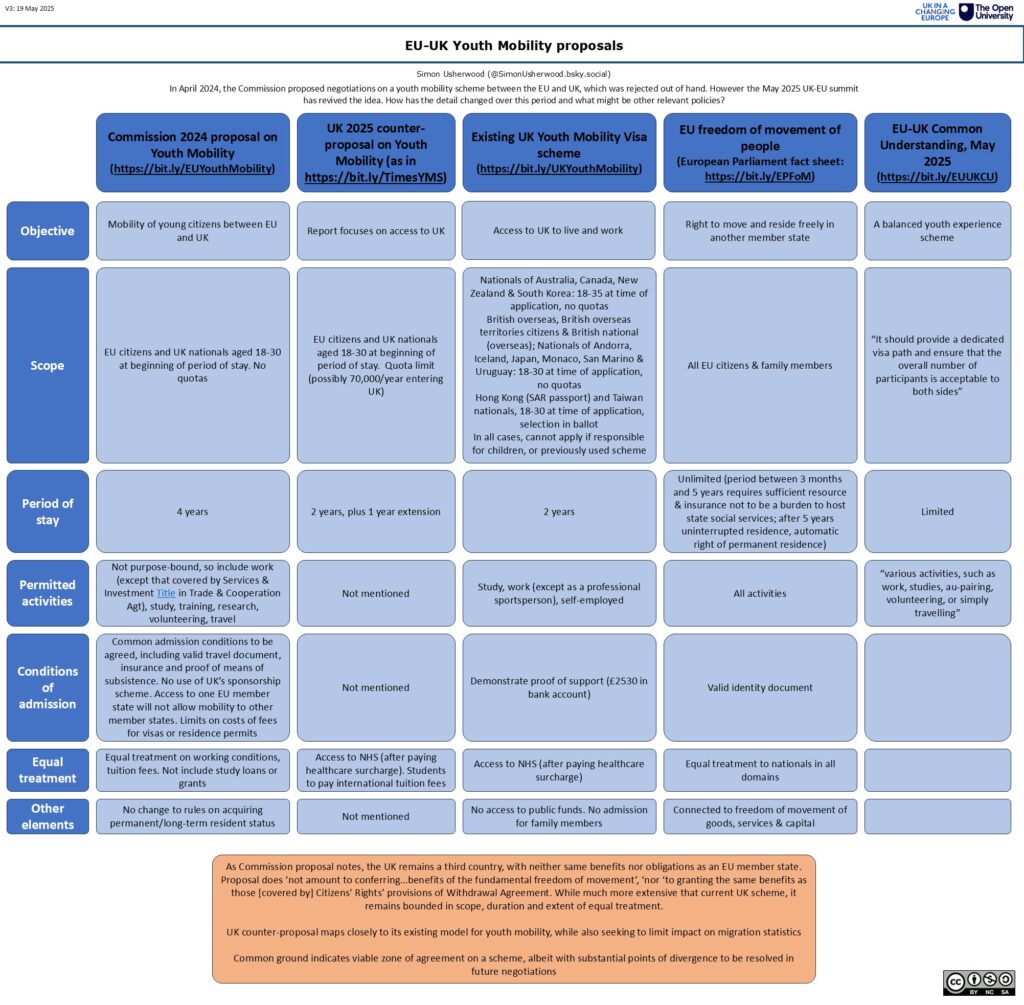
Since the 2025 summit, those gaps (on caps on numbers, university fees and permitted activities) have not definitively closed down. Instead, there has been a steady drip-feed of briefings by both sides to try to signal intent and (less often) offer possible landing grounds.

The following is a list of all Financial Times stories that include such briefings, the paper being a convenient shared space for negotiators:

  • 7 November 2025. ‘EU officials’ flag the need for the scheme to be drawn up as a binding legal instrument, rather than the memoranda of understanding the UK has with other third countries
  • 5 December. A leaked EU ‘draft text’ has no cap on numbers, and gives EU students access to UK university fees
  • 15 March 2026. ‘UK officials’ offer to give way of fees, in return for a cap and other concessions
  • 5 June. ‘UK officials’ reiterate their offer on fees
  • 3 July. The ‘Commission’ says the proposed cap is too low, EU nationals need to be exempt from the NHS surcharge and have access to UK fees
  • 13 July. ‘EU diplomats’ say the cap offered by the UK is a ‘non-starter’ and repeat points on the surcharge and fees
  • 18 August. ‘EU diplomats’ again say the cap offered is too low, but might consider something in the ‘low 100ks’, and say fees is ‘vital’
  • 23 August. A leaked UK negotiating brief from ‘UK officials’ says Starmer was willing to concede on fees and up to 100k on the cap, in return for access to Made in Europe or steel tariffs

This procession suggests a number of points that speak to the wider relationship.

Firstly, the UK has moved further than the EU on these points. We might reasonably assume that the EU will get domestic fees, but without any evident quid pro quo on caps or other dossiers. Indeed, when such cross-linkage has been mentioned by the UK, the reply from the EU has been very dismissive. This reflects the underlying asymmetry in the relationship: the UK needs this more than the EU, and the EU knows this.

Secondly, this is as much evidence as we have that Burnham is not going to stray very far at all from Starmer’s positions: The PM was talking again about Made in Europe in his first PMQs this week. Whether that helps or hinders progress on negotiations remains to be seen, but the sense that Brussels was ultimately underwhelmed by Starmer’s translation of rhetoric to action does not look set to be challenged by Burnham any time soon.

Finally, it points to the perils of low-stakes negotiating. None of the items on the table will be of notable macro-economic significance for either side, but instead act as markers of good intent and willingness to try to keep the wheels spinning on the minimal architecture of the Trade & Cooperation Agreement’s free trade area. Part of this might be the anxiety over who will be in power in the UK following the next general election, but more of it is that neither side see their relationship as either particularly important or in need of urgent attention. With plenty of other things to be getting on with, this is something that lacks any strong sense of pressure to wrap things up.

Of course, it’s still early days, but if the last seven PMs have taught us anything, then it’s that their revealed preferences on EU policy are pretty clear, pretty quickly.

Posted in Uncategorised | Tagged , , | Leave a comment

The boundless mystery of Assimilated EU Law?

This piece was originally published on the UK in a Changing Europe site.

It’s something of a truism to say that Brexit is a process, not an event, but nowhere is this more evident than in the UK’s continuing difficulties in managing the pieces of legislation it adopted during its time as a member state of the European Union (EU).

As we close in on a decade since the 2016 referendum, it is apparent that there is still no final and definitive list of that legislation, nor clarity about what should be done with it all. With multiple negotiations in train on renewed cooperation between the UK and the EU, that will raise increasing problems for both sides.

Following withdrawal, the then-Conservative government largely turned its back on things European; partly because of the Covid-19 pandemic and partly because of the intense discomfort the issue had wrecked within the party over the previous decade. But one area that continued to pop its head up was Retained EU Law (REUL) – assorted Statutory Instruments, primary and secondary EU legislation, case law and more which the UK adopted as a member state, and copied over as ‘assimilated’ UK law during the Brexit process.

Business Secretary, Jacob Rees-Mogg, introduced legislation in September 2022 which would see all REUL expire by default at the end of 2023 under a ‘sunset clause’, except in cases where ministers actively chose to retain or reform specific pieces. That legislation, which was to become the Retained EU Law (Revocation and Reform) Act, was intended to mark a definitive break with REUL and a restoration of British sovereignty.

However, it very quickly became apparent that there was no clear record on what that might cover, which made it impossible to know whether it served any useful function or whether revocation might cause unanticipated consequences for either domestic or international obligations. With much push-back from legal scholars, businesses and other groups, as well as backbench rebellions, the final Act took a much more limited approach, abandoning the sunset clause and instead revoking only 600 items of REUL, while instigating a process for identification and review of everything else.

This process centres on a database – the REUL dashboard – which details every known item of REUL and case of reform. It has just had its regular six-monthly update, to list some 6,925 items, alongside regular reports to Parliament on progress.

The latest update is the eight substantive revision of the database from its original 2,417 items in January 2023 and marks approximately two years since the last step-change in the overall picture. Back in early 2024, over 1,700 new items were added, following the completion of a new scoping exercise across Whitehall.

Since that point, a further 168 items have joined the list, including 14 in the most recent period. This discovery includes EU decisions similar to those that have been on the Dashboard for years, and domestic legislation nearly 30 years old, highlighting the difficulty of ensuring a comprehensive coverage.

But such top line figures, which are the lead indicator on the Dashboard, mask a second kind of problem; namely that the data isn’t as robust as you might expect, or as is needed for this entire exercise to have meaning.

The database still contains several items that are there as queries as to their possible inclusion. Such cases have occurred before – for instance the removal of initial entries about the effect of several articles of the Treaty on the Functioning of the EU.

There are also instances where multiple references to specific provisions of an item have been rolled into a single entry, as with the Social Security Contributions and Benefits Act 1992, which started as four separate elements.

However, more common has been a one-off entry that appears to be within scope of the REUL Act, but then seems to disappear. To pick one example, the January 2023 list mentions Commission Delegated Regulation (EU) 2018/631, which appears to have been revoked in 2020, but then disappears from the database entirely. While this might be understandable as something pre-dating the exercise, it is noticeable that the previous item in the database, Commission Delegated Regulation (EU) 2018/63, was similarly repealed in 2023, but still remains present.

Different again is the Sexual Offences Act 2003. The January 2023 entry clearly indicates its role in implementing an EU Council Decision that was subsequently listed in the database, but which makes no reference back to the Act. While these might be treated as a package, the lack of complete cross-linkage makes it very hard to know what item has what status.

In total, while there are 6,925 entries in the current Dashboard, it is possible to identify approximately 7,500 unique entries across the period since the first release. Some 600 items that appeared at some point in the past (often more than once) are absent from the Dashboard today.

Such inconsistencies are a function of the complexity of the UK’s membership of the EU. Some 40 years of incorporating a large volume of legislation – often through secondary instruments – with no immediate need to keep comprehensive and exhaustive records has left an almost impossible task for those in the Department of Business and Trade who run the Dashboard.

However, given that the programme of reviewing Assimilated EU Law appears continues under the Labour government, with 22 amendments and 19 repeals in the last six months, the need for clear, consistent and accessible data remains as high as ever.

At the same time, the demand on resources within the civil service to conduct such reviews also represents an opportunity cost, especially at a time when the government is embarking on multiple negotiations to pull the UK closer towards the EU in legislation-rich topics such as sanitary and phytosanitary standards and emissions trading.

Absent a clear strategic objective, there is a risk that officials spend time reviewing, amending or repealing REUL which they will soon have to be reinstate or amend once again: from decisions about SPS processes to regulations verification of emissions data.

Posted in Uncategorised | Tagged , , | Leave a comment

New year, same old UK-EU relations?

I notice it’s been some six months since my last post here, which reflects on both the new pace of UK-EU relations and the lack of anything useful to add to the debate.

I did bestir myself to write about the return of finance-based framing back in November, as various people noticed this was a thing, but even that was a very brief matter (albeit one we might return to).

Even the recent number of press stories launched by Labour about the new for a closer relationship currently lack any great depth: the items that are being mentioned relate to stuff already on the reset agenda, which have themselves moved at a glacial pace. The failure of SAFE negotiations in November was undoubtedly a set-back and one that helped to move up the ERASMUS+ decision some weeks later, but this has deflected attention from the lack of quick movement elsewhere. Even the Spain-UK treaty on Gibraltar, agreed last June, is still to be put through ratification.

At best, this suggests that things might be moving forward, rather than are demonstrably doing so. Even if we make allowances for the likely cross-linkage of ETS, SPS and Youth Mobility, there risks being little to show come the next EU-UK summit, whose date is still to be fixed.

Ultimately, this reflects on the lack of urgency for either side. The EU has many other more pressing things to attend to right now, while British policy is caught up in the general funk about the government’s central strategic purpose. Moreover, none of the reset elements will actually make a huge difference to those involved, beyond helping to remove some points of friction and to rebuild trust.

However, with Labour languishing in the polls, the EU might be forgiven for wondering whether it’s worth moving now on more relations, when a new British government might come along a tear those apart in three years’ time: witness the flourishing adoption of ECHR withdrawal on the right that continues to contain no concern about the impact on the TCA/WA.

This all said, it’s good not to be too downbeat about things. The rhetoric remains positive, negotiations do continue and British public opinion is still relatively benign on closer links.

As such, I’m going to try to be more active this year as we move through the reset, looking both at the specific elements and the wider relationship. As ever, I’m always very happy to produce graphics on particular things: just contact me and I’ll be on it.

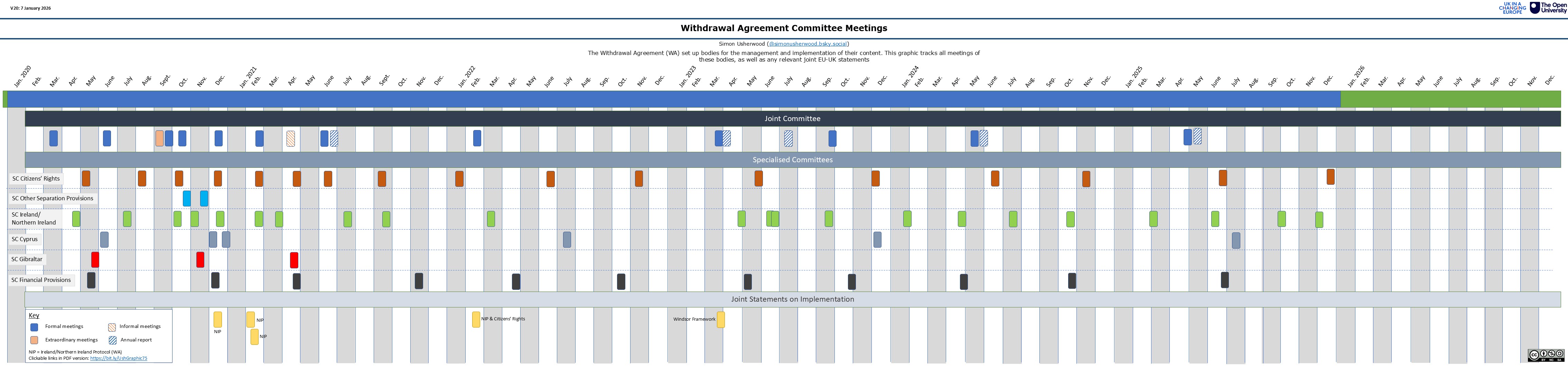
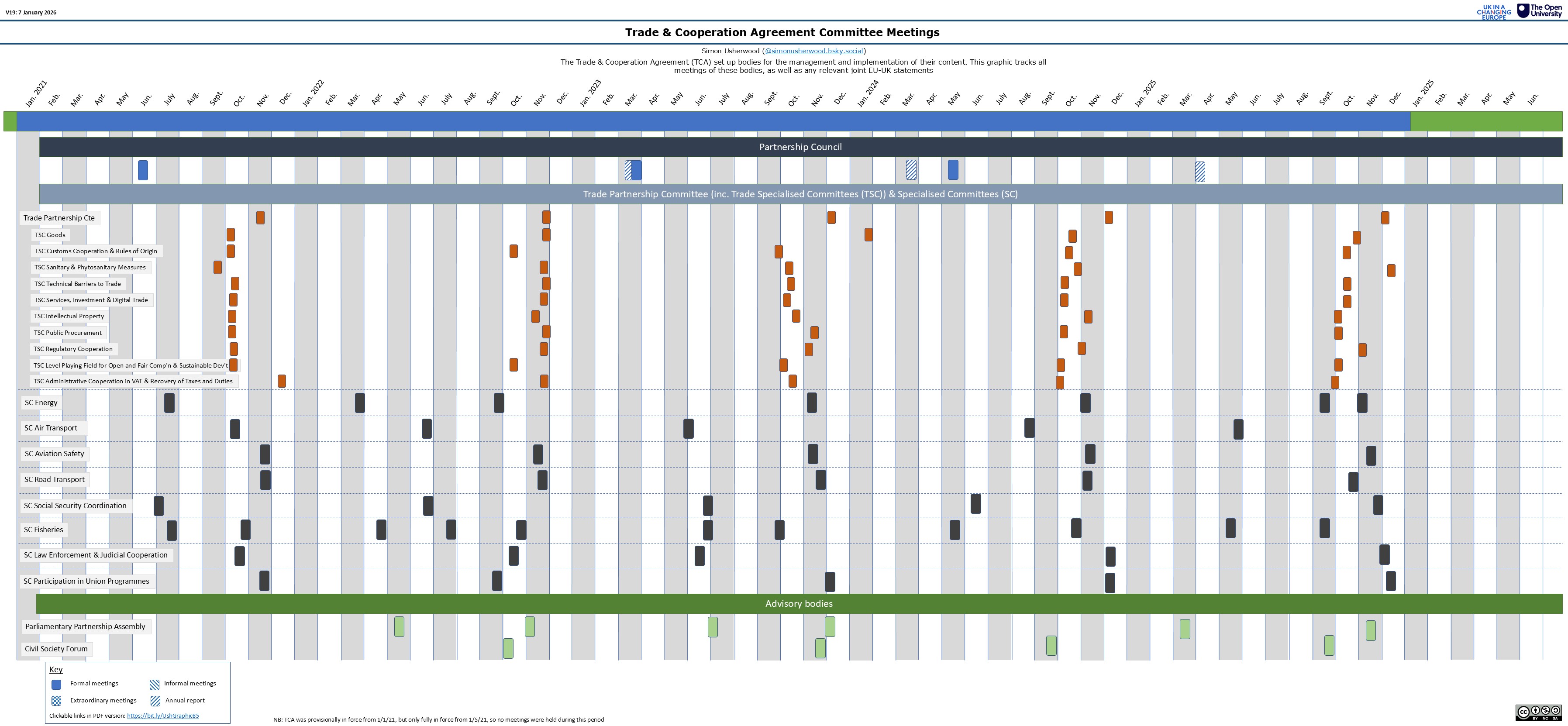
In the meantime, here are some updates of the main trackers on WA/TCA meetings and the progress on the Strategic Partnership. As always, you can follow the links to the PDFs with clickable links to source documents.

Posted in Uncategorised | Tagged , , , | Leave a comment

Tracking the UK-EU reset

Following the EU-UK summit last month, I’ve finally got my ducks in a row on trying to track the substance of what follows.

You’ll recall that apart from the Security & Defence Partnership, there was not a single definitive legal instrument. Instead, there was lots of language about ‘working towards’ things or ‘exploring possibilities’: all very nice, but not really enough in an era of questions about the depth of international commitments.

Hence the tracker. As I’ve noted in my Bluesky thread on this, I’m only tracking those elements that seem to produce a formal agreement between the parties: potentially the list could grow, but let’s wait and see.

Rob Francis has written that Commission mandates for SPS, ETS linkage and Youth Experience aren’t coming until the autumn of this year, so formal negotiations seem unlikely until the back end of 2025. Given that each of these could throw up a bunch of issues (such as how much the UK is prepared to accept EU rules, and how much this is going to cost in contributions), reaching an agreement on any of these by the time of next spring’s summit looks hopeful.

Hence the tracker covers the entire lifetime of this Parliament.

Of course, if polls continue to be as unclear as now, the shadow of a non-Labour government is liable to cast a shadow on any negotiations from about 2027 onwards (given the time it’ll take to conclude, ratify and implement any individual deals), so this is the best opportunity for both sides to nail things down and minimise the chance of new administrations making bold choices.

As for the rest of the list, I’ve seen nothing to indicate timelines. Even if most of it is highly technical, it’ll still need work and political attention, something that’s been in short supply so far.

So the big question is whether long-term incentives will outweigh short-term distraction.

Posted in Uncategorised | Tagged , | Leave a comment

We’re gonna need a bigger tracker…

One of the joys of listening to Radio 4 is that while having my regular daily walk yesterday I heard a lovely discussion about the 50th anniversary of Jaws, the film that created the summer blockbuster and gave us some top meme-worthy comment.

It feels apposite to mention this because one of my main takeaways from this week’s UK-EU reset summit was the realisation that we are now entering a semi-permanent state of negotiations between the two, which in turn means more work for me and further vindication of my decision to stick with studying UK-EU relations. Truly one of the last jobs for life that people used to have.

Since I’ve been busy having such thoughts, I come late in the day to the business of analysing the various documents produced on Monday: the Joint Statement, the Common Understanding and the one actually-concluded document, the Security and Defence Partnership (SDP; half of which is cribbed from the EU-Japan piece, as Anton Spisak notes) . You’ll also want to read the Commission’s Q&A, since it’s less ambiguous about what’s what.

If you want run-throughs, then I recommend Anton’s piece, as well as David Henig‘s and Steve Peers‘, the last of which is worth quoting at a bit of length for its conclusions, with which I fully concur:

Finally, it’s notable how many Rubicons have been crossed with this reset deal. As noted already, the UK now accepts the market access/integration trade-off. But the EU now accepts agreeing this trade-off with the UK in limited fields: the UK can have one foot several steps up the Barnier escalator, but the other one firmly on the ground. The EU has also accepted a Swiss-like complex legal relationship with the UK, having opposed it in principle for years. (In fact, the EU already conceded this point when agreeing the TCA; but that treaty hid its legal complexity better than the reset deal does). The UK has accepted an agreement with the EU as regards movement of (some) EU citizens; although it might claim this arrangement will simply resemble its youth mobility treaties with many other countries, the extent of that similarity will be dependent upon the details of the final deal. Above all, the EU, having accepted freer movement of some goods and demanded the freer movement of some people, can no longer lecture the UK on cherry-picking or cake-eating – what with all the crumbs and cherry juice smeared across the EU’s own mouth.

Rather than rehashing all these colleagues’ fine efforts, I’ll stick to adding some further thoughts.

Substantively, the package here is both more extensive than most had anticipated and less developed. Rather than sticking the Nick Thomas-Symond’s three-basket model we have a Common Understanding with five main headings, plus the bits that don’t fit in within them, like fisheries and the very idea of regular UK-EU summits.

At times, this all reads like someone has asked ministries/DGs to throw in anything they’d like to see discussed, which might not be a million miles from how the process went in the UK, but it sets a wide open terrain for negotiation.

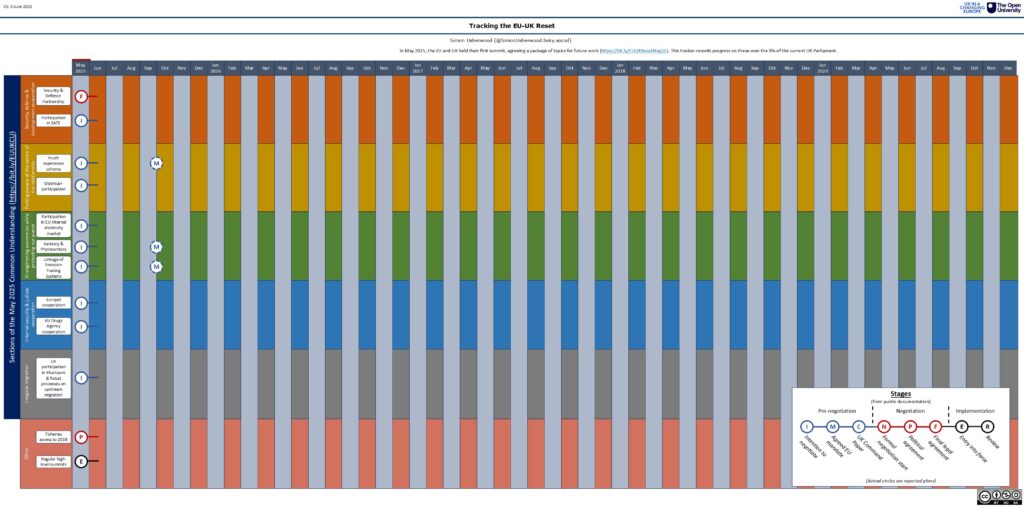
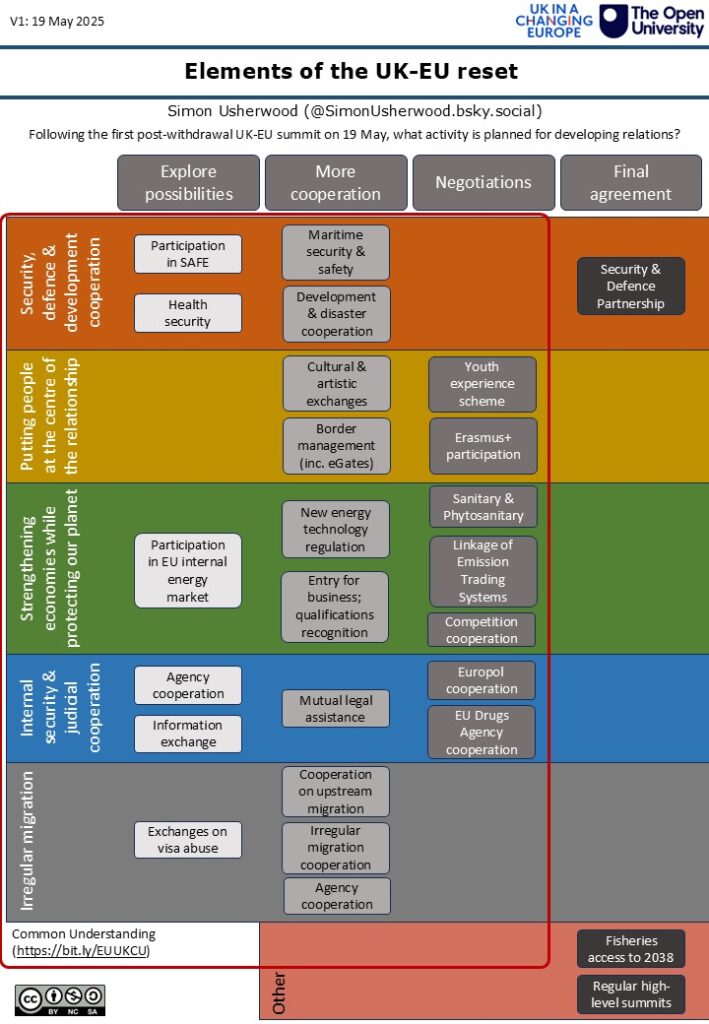
And it is negotiation. Barring the SDP, there is not a single final decision. Even the fisheries access that generated much interest in the British press is only a political agreement, with a legal text at least a month away. As I note in my summary graphic below, there are a handful of commitments to negotiate, plus more vague intentions to do more together or to ‘explore possibilities’.

Moreover, there’s not a single date for any of this to happen, even the topics that both sides agree will be negotiated. Therefore an early marker of how much effort is being put into this will be the speed with which the Commission produces and agrees mandates for SPS, Emissions trading, Energy market integration and youth mobility/experience.  The speedy release of the competition cooperation text on Tuesday might be a good sign, but equally the fact it wasn’t ready to go with this package suggests that none of this will be easy.

On that point, it’s clear that this is not an era of unbridled euphoria and working together, but regular international relations, with each side pushing its interests hard. The French squeezed on fisheries over the weekend, just as the British evidently got youth mobility/experience parked to avoid more “it’s not freedom of movement” arguments that would just further link that scheme to freedom of movement in people’s minds (as more than one person has commented to me this week).

Indeed, it is the practice of the UK government in all this that raises the most concerns.

Across public policy there appears to be a profound aversion to open policy-making, instead keeping things in-house and driven by focus-group polling. It’s not necessarily wrong, but it does raise the risk of generating policy that lands badly. In this case, the harrumphs from devolved bodies, scrutiny bodies, sectoral interests and others with interest in the matter speak to the consequences.

A case in point is eGates. This was something that has been under negotiation for quite some time, held up by the EU’s delays in implementing the Entry/Exit System and some member states’ quibbles over legal barriers. The government decision to present this as an immediate benefit very quickly fell over in the face of, well, facts and took away from what was still a story that would have been a positive selling point.

If we are now entering a permanent negotiation then the government will need to work more on its narrative around this process. To return to Steve’s quote earlier, this isn’t an escalator back to membership, but equally it’s not clear what the underlying logic is. Put differently, everyone knows the government’s red lines, but it’s not clear why those are red lines.

As more and more cooperation occurs, that will mean more and more instances of the UK becoming a rule-taker: SPS, ETS and energy markets are all explicitly framed this way in the Common Understanding. That creates a discursive tension with the control that has been taken back, which requires some vision of why this works to be articulated.

Therefore, my second big indicator will be the extent to which the government is both able to articulate that vision and the effort it puts into so doing. The three-basket model was evidently a placeholder, but the public statements from Starmer this week don’t offer a replacement beyond the UK ‘being back’.

This will matter when the various negotiations start to come home to roost. While there is no explicit cross-linkage, undoubtedly that will occur at points when it suits one or more of the parties involved: remember too that all of this is happening on top of the previously-described reviews and negotiations within the TCA itself.

Youth mobility/experience is perhaps the most likely flashpoint. The wording on Monday was a classic piece of “we have agreed absolutely no principles or even whether it will happen at all”: as I’ve written for The Conversation, the problems are almost all domestically British ones, even as the EU genuinely struggles to see the issue. But now it’s a totemically-important item for some member states, there will have to be some kind of reckoning.

So, early days on all this.

What matters is partly about political will on both sides, but also about capacity. The lack of interest in European media was palpable, reflecting the low salience of building more ambitious relations with a country with whom the EU already has a serviceable relationship. There has been no public discussion about whether the British machinery of government has the capacity or skills to run multiple, permanent negotiations of a kind that it hasn’t tried before.

Monday was full of good vibes and warm words, but it’s not those moments that will define how the relationship works in practice.

Posted in Uncategorised | Tagged , , , | Leave a comment

Circling the wagons

Not so much a post as a list of links for you this time, as I’ve been working up from a thread on BlueSky to a graphic to a podcast.

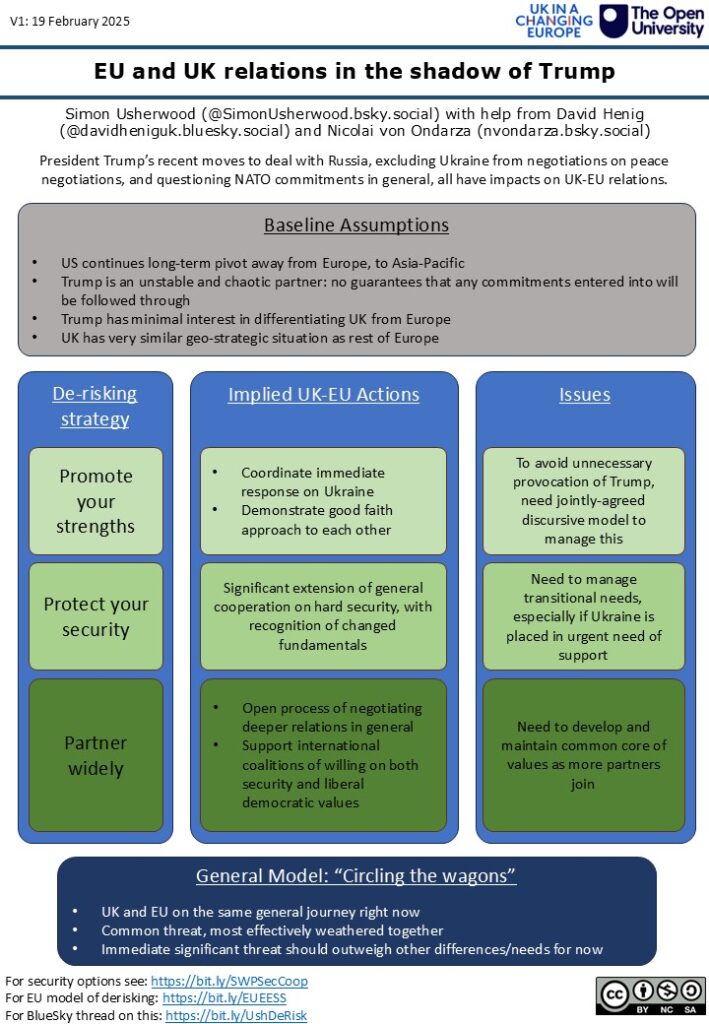
The central theme here is how the UK-EU relationship is affected by the chaotic Trump administration in the US, particularly in the wake of his moves on Ukraine, Russia and NATO. Much as the EU had to respond to the UK’s stated willingness to break good faith during the Brexit negotiations, so too do the UK and EU now jointly need to respond here.

Of course, part of the problem with chaotic situations is, well, the chaos; you don’t know what’s coming next. Hence the title of this; circling the wagons to defend against the immediate threat, even as you want to continue on a longer journey.

As well as trying to work out some baseline assumptions, I also suggest what is in effect a holding model for the long-term relationship while the pressing needs around Ukraine can be addressed. I’ll not pretend it’s all that satisfactory, but we seem to be living in a world of less-than-satisfactory situations, so tough luck on that one.

Any way, back to the links.

We start with a first thread on BlueSky:

https://bsky.app/profile/simonusherwood.bsky.social/post/3liel7pudlx2y

This was essentially working through the unsustainability of UK hedging in the new context.

Then we move to a bigger thread:

https://bsky.app/profile/simonusherwood.bsky.social/post/3lijgqhoguf2e

This sets out the basics of my thinking, including discussion of the circling the wagons approach as a manifestation of a de-risking strategy. Particular mention needs to be made here of Nicolai von Ondarza’s work on security arrangements, which is excellent on the specifics of how the UK and EU could move to more institutionalised dealings. If you want more on de-risking, then I’ve worked off the EU’s European Economic Security Strategy.

If that’s all too much, then here’s a graphic form of the key bits:

And finally, if you just want to listen to me talk it out, then I’ve made an episode of A Diet of Brussels on all of this. Incidentally, I note I’m coming up to the tenth anniversary of the pod and I really didn’t think back then we’d be thinking about these kinds of things: I was right to think that we’d be banging on about Europe though.

Small victories, I guess.

And all of this is very much up in the air: would love to get your feedback on any or all of this as we proceed.

Posted in Uncategorised | Tagged , | Leave a comment

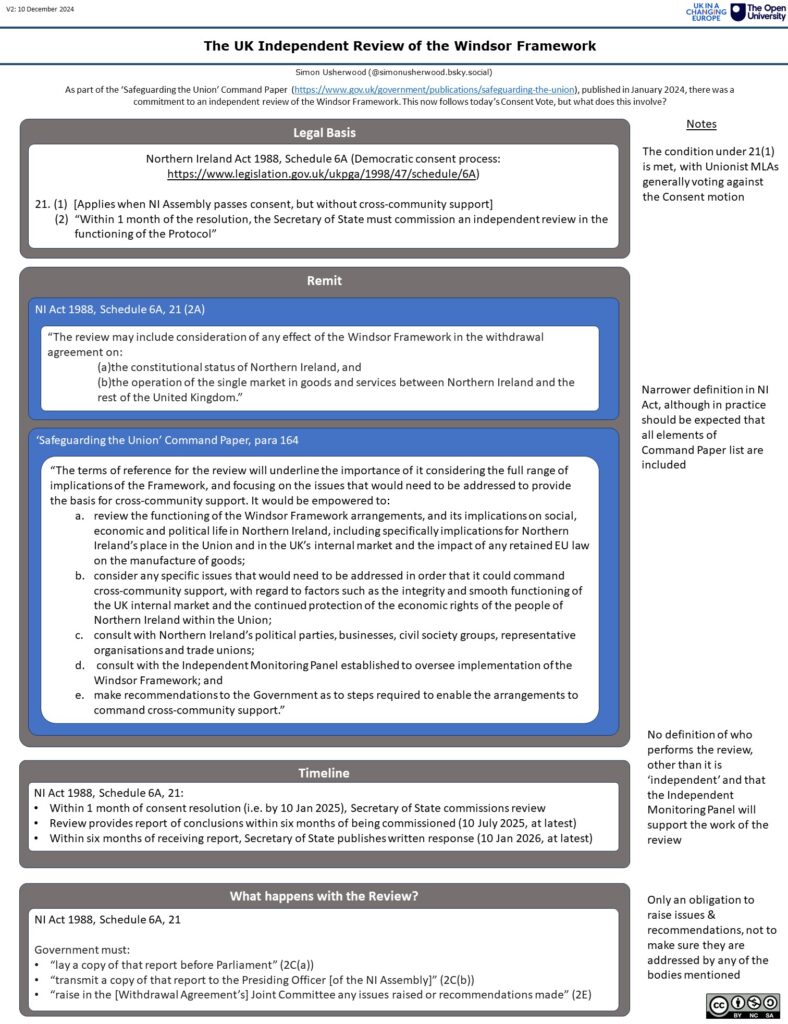
All quiet on the Protocol front

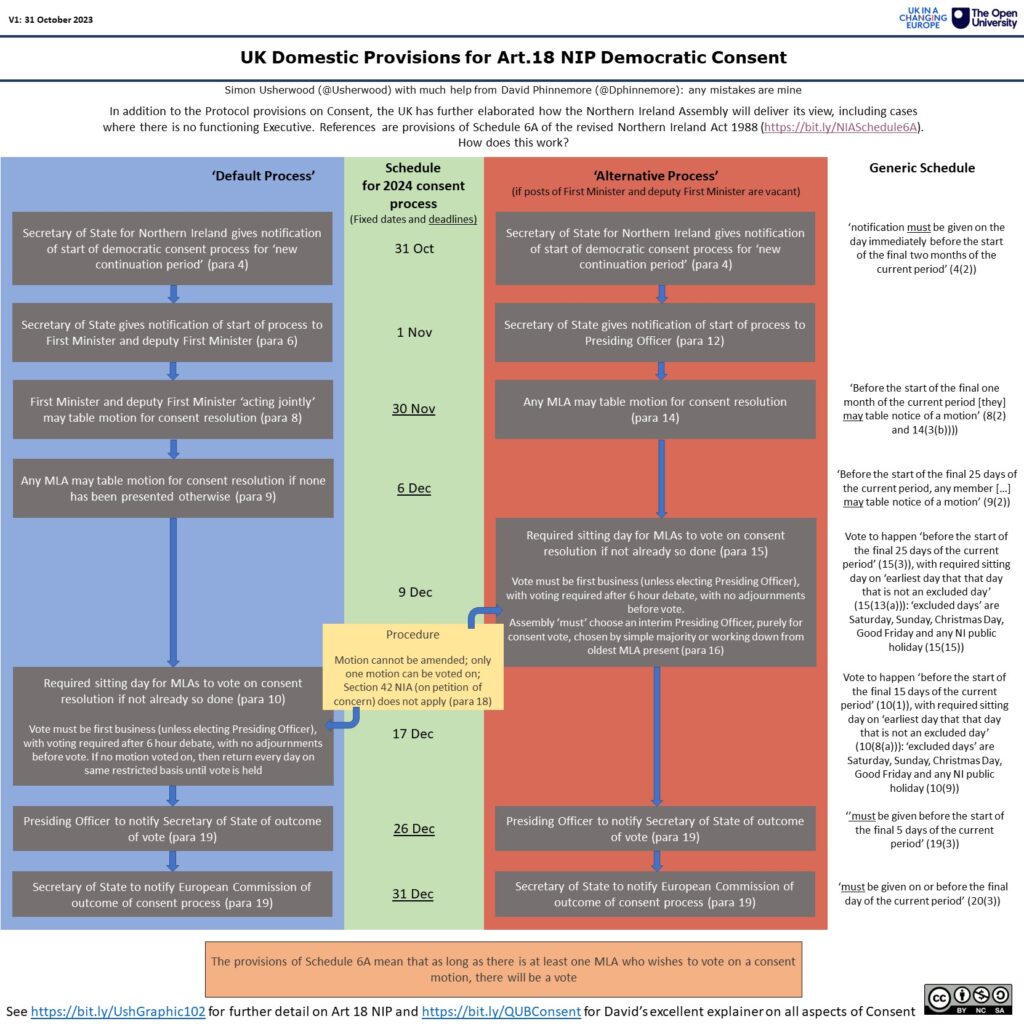
This week’s vote on the Consent motion was unremarkable enough that there was hardly any media coverage in the run-up, even in Northern Ireland itself.

Positions had been long-known and the result (a simple majority) was a given, despite the (sometimes long-winded) efforts of some MLAs to convince others.

For a mechanism that had raised so much interest back in 2023 in the Windsor Framework, this might be seen as a victory for boring politics.

But to watch the debate unfold – as I did for a few hours – was to be struck by the shallow foundations on which the entire NI Protocol rests. There was scarcely a voice raised that thought the Protocol was a good thing for Northern Ireland.

Instead, those voting in favour of its continuation for another four years spoke of it being a necessary consequence of a decision to leave the EU that had been foisted upon the region by voters in England, and the least bad option among a menu of all bad options.

Likewise, even if Unionist arguments about EU laws being imposed upon Northern Ireland without local agreement were somewhat undercut by others observing that the Unionists had said how wonderful the Windsor Framework would be only 18 months ago, there was still some sympathy for the view that the Protocol wasn’t what Northern Ireland would have chosen for itself.

As we now move into the UK’s own review of the Protocol, perhaps some of these dynamics will come out more properly, to allow for the finding of some common ground. But even if Unionists can reconcile with others about what to do, they still need to convince both London and the EU that this is worth reopening a topic that caused so much grief last time around.

Northern Ireland is thus likely to find itself locked into a system that it barely tolerates and in which there is limited scope to build durable accommodations. A fundamental shift in British policy – towards joining the customs union or single market, say – is far beyond the horizon, so the local arena is likely to remain the primary one.

As attention drifts away from Belfast, the danger of an accidental crisis grows: someone in Brussels forgets to check the implications of a piece of legislation; someone in the Assembly doesn’t realise the effects of some routine directive; someone in London fails to connect broader developments in relations to the Northern Irish case.

While I think we can all agree that a return to the ‘hot Brexit’ period is very much to be avoided, that should not blind us to the perils of more mundane relations.

Posted in Uncategorised | Tagged , , , | Leave a comment

Visions, strategies and plans: Deconstructing Labour’s EU policy

Headaches in the morning

Maybe it’s some kind of Stockholm Syndrome, but since the Tories left office I have not felt the same urge to write about British European policy.

Equally possibly, it might be because I feel a bit broken by another government with a lack of clear purpose in this domain. Labour, like their predecessors, seem to be stuck at the point of realising this whole Europe thing might be a bit more complicated than they thought, so extemporise until they can work it all out some more.

This was brought to a certain head last week for me off the back of some comments I made in an interview. In it, I said:

“The secrecy right now lets others claim he [Starmer] has no plan – or worse, is just looking to make deals where he can.”

Various people have pushed back on this, mostly by reading it as ‘Starmer actually has no plan’. While I’m not quite arguing that, the impression that this is the case seems somewhat self-evident: communication is focused on what won’t happen – free movement of people, membership of Customs Union or Single Market – and on the nebulous ‘reset’.

This needs more thought and reflection, because there are several things going on here, all of them consequential and none of them clearly determinant.

First up, we need to be a bit clearer about what we’re/I’m talking about. In the broadest terms, there’s a difference between what we might term a vision, a strategy and a plan.

David Henig’s fine piece speaks to this difference by noting that we know what the UK wants of working with the EU; namely cooperation in any and all areas within the envelope of non-membership of the Customs Union, Single Market or full EU membership. That includes the usual litany of items such as an SPS agreement, fisheries access and security.

That is a plan (or rather, a series of plans); specific and localised actions to take. But it’s not really a strategy or a vision.

The UK has long failed to settle on – or even consciously discuss – its vision for relations with the EU and its predecessors. The point of relations sits uneasily in the wider uncertainties of how the UK wants to position itself in the wider world or of what kind of place it wants to be. You can insert your favourite Dean Acheson quote here [although seeing the other two ascribed to him, it might become my least favourite one].

Below any high-minded vision of who we are and what’s our place in the world, there is strategy, which starts to translate down towards the broad thrust of activity. In this case,  the questions are whether the current red lines are fixed and whether they derive from some higher purpose or instead are a function of party politics of the last few years.

Put differently, there’s nothing wrong with red lines, but you need to be able to understand why they exist and what purpose they serve if you are to defend them and to use them in your negotiations with the EU.

In this, I’m rather old-fashioned in thinking that party politics most usefully stops at the water’s edge and that external relations should speak to the needs of the country as a whole. But your mileage may vary on this.

At present, the defining mechanism seems to be one informed by the imperatives of trying to neutralise a tricky topic in party political terms, while also recognising specific needs and asks, combining to produce the external relations version of the Woolie’s pick and mix: lots of choice, lots of things you’ve never seen before and not the most sustaining of diets.

Secondly, we have to be alive to why people talk about wanting a vision/strategy/plan.

Clearly, the lack of strategy or vision is not for lack of ideas out there. The absence of a more articulated Labour policy has left groups from across the political spectrum to offer programmes and priorities (this is a good place to get some overview).

Because these are typically isolated from the need to attend to the party politics that the government has decided to be hemmed in by, they come with their own visions and strategies.

Right now, a lot of that comes from pro-European voices that take doing (much) more with the EU as A Good Thing. The youth mobility impasse has been a recent rallying point for them, both on what they see as intrinsic merits and on wider signalling or a desire to multiply connections.

Even my own position – that the government needs its own vision and strategy to create a durable relationship with the EU – still comes with an agenda of wanting to avoid big swings in policy.

From the government’s perspective, this is a complication: moving on a specific point risks opening up broader implications for relations just at the point when they seem to wish to hold off such things. Hence, havering on youth mobility despite very broad backing from interested groups and public opinion.

Again, this comes back to the lack of a robust vision and strategy that the government can lean on as justification for what it’s doing.

Finally, we have to separate rhetoric and action.

Just because politicians and pundits talk in a particular way, it doesn’t mean that they follow through on that in their action. In the present case, there is clearly a huge amount of interaction and activity between the UK and EU (again, a good overview here).

Last year’s fun over EV car batteries is a case in point, where lots of work went into avoiding a mutually-damaging situation: exactly the kind of issue that bubbled along in the specialist media, but which would have been a much bigger problem if not addressed.

To that extent, lacking a strategy hasn’t held back a lot of work, on things that need dealing with now.

But working towards any kind of relationship that is robust and resilient requires more than just reactive management of stuff that pops up. As the 2000-2010s showed very vividly, lots of small choices and steps can lead to radical outcomes: ‘not banging on about Europe’ became ‘let’s not talk about it’, leaving others to fill the gap.

—

To pull all this together, Labour’s issue appears to be not that dissimilar to David Cameron in the 2000s: a desire to park the ‘Europe’ issue and deal with other things that needed attention (and don’t cause so much anguish) leaves the field open to others to make their play for agenda-setting, which probably results in outcomes that are ultimately more adverse for the government than would otherwise have been the case.

This points to the need for finding a happier medium between obsessing and ignoring EU relations. Like any other significant part of public policy, there has to be sufficient engagement to follow through on agendas/visions if that is not to become a point of instability.

Knowing what you aim to achieve – and why – would be a helpful start in determining that level. To delay will only reduce options and make it harder to impose order and stability over the relevant activity.

Posted in Uncategorised | Tagged , | Leave a comment